Image

Elizabeth Horn
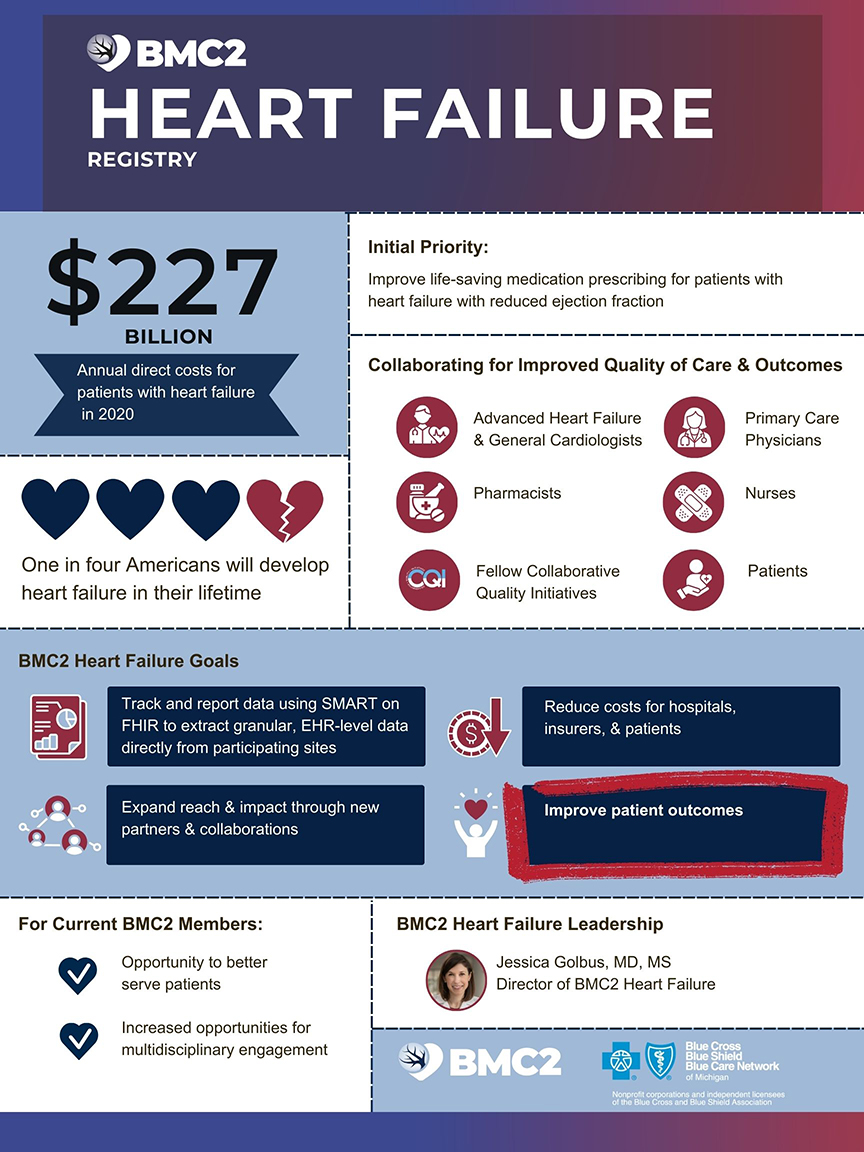
One in four Americans will develop heart failure in their lifetime, and Michigan has one of the highest rates of heart failure in the nation.
The forthcoming population health-based registry, BMC2 Heart Failure, will strive for improved clinical outcomes, lower costs, and sustainable value for Michigan patients with heart failure and the sites that care for them.
Jessica Golbus, MD, MS, a Heart Failure and Transplant cardiologist and expert in outcomes research and clinical trials, will lead the overall implementation of the registry and oversee its quality improvement efforts as the registry’s director.
“BMC2 Heart Failure will leverage the structure and expertise of the BMC2 Collaborative Quality Initiative,” Dr. Golbus explained. “It will also partner with existing physician organizations within the Blue Cross Blue Shield of Michigan Physician Group Incentive Program to improve outcomes through cross-center, multidisciplinary collaboration.”
Assembling BMC2 Heart Failure
An advisory panel including advanced heart failure and general cardiologists, primary care physicians, pharmacists, and nurses from across the state of Michigan will establish a shared set of priorities to guide the design and implementation of the registry and inform subsequent quality improvement initiatives.
Mike Dorsch, PharmD, an expert in clinical informatics and patient decision aids, will lead the development of a data pipeline with actionable reporting for specialists and physician organizations alike.
The BMC2 Coordinating Center team will grow and provide support and resources – including interactive digital tools and communications – that enhance engagement across all stakeholders and increase the sustainability of quality improvement.
Initial Priority
Safe and appropriate prescribing of four disease-modifying medications, including an angiotensin-receptor neprilysin inhibitor, beta-blocker, mineralocorticoid receptor antagonist, and SGLT-2 inhibitor, has become best practice for patients with heart failure with reduced ejection fraction, a condition where the left ventricle's pumping function is weakened.
The estimated cumulative effect of these four medications includes a greater than 70% relative reduction in mortality over two years. Despite this, few patients are on all four medication classes. This likely represents barriers to care at multiple levels, many of which the current registry hopes to shed light on and help address.
The initial priority of the registry will be creating scalable models and quality initiatives to improve medication prescribing for patients with heart failure with reduced ejection fraction. Then, to expand in later years of the registry.
Nick Osborne, MD, MS, BMC2’s Program Director and Director of BMC2 Vascular Surgery, said, “Establishing BMC2 Heart Failure launches an exciting new era. We are building on BMC2’s 30-year-long impact, improving quality of care and outcomes for patients not only here in Michigan, but across the nation and world.”